OKO Finance - your personal wealth companion
About
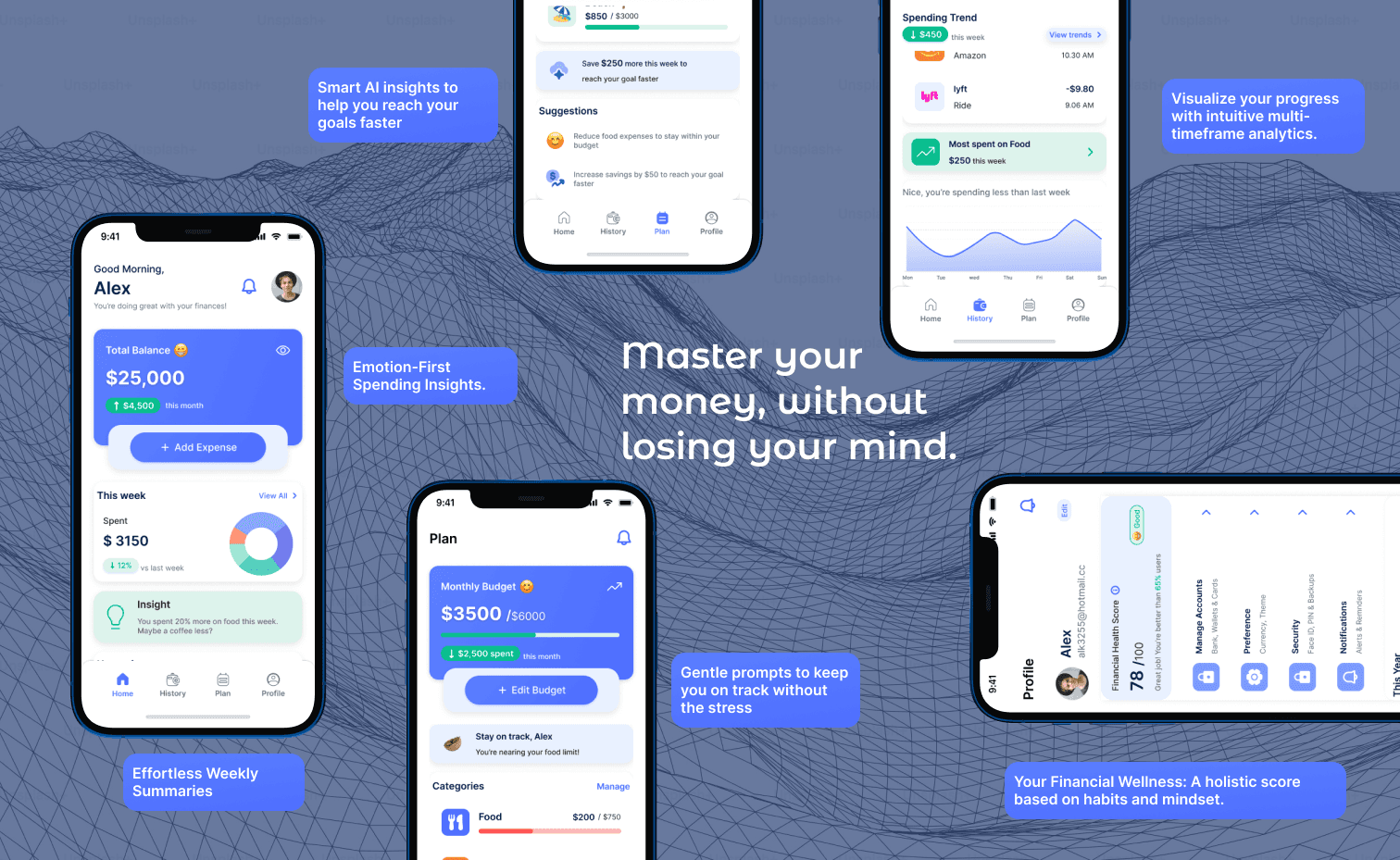
OKO Finance is a personal wealth companion designed to simplify financial management for young professionals through soft minimalism and behavioral design. The design uses soft minimalism and rounded geometry to eliminate the intimidating, "spreadsheet" feel of traditional banking. By prioritizing a visual hierarchy—placing the total balance and emotional state at the top—users gain instant financial awareness with zero cognitive load
Pain Points
Lack of Actionability - Seeing a transaction list provides "What" happened, but doesn't tell the user "How" to improve, leaving them stuck in the same cycle.
Information Overload - Standard apps present too many numbers at once, making it difficult for users to quickly understand their "safe-to-spend" balance.
The "Guilt" Factor - Traditional budgeting feels like a reprimand. Users feel judged by "Over Budget" alerts, leading them to close the app rather than solve the problem.
Invisible Triggers - Users often don't realize that their spending is tied to their emotions (e.g., stress-ordering food), making it hard to break bad habits.
Project Goals
Demystify Financial Data
Reduce Financial Anxiety
Encourage Behavioral Change
Identify Emotional Triggers
Streamline High-Friction Tasks
Intention
Reduce Financial Anxiety
Bridge the Emotional Gap
Drive Actionable Clarity
Visual Goal Alignment
Target Users
Young Professionals
Freelancers/working professionals
Students who are starting out to manage their financials
Summary
OKO Finance successfully redefines personal wealth management by prioritizing emotional intelligence and visual clarity. By replacing cold, technical tables with narrative illustrations and conversational AI insights, the project transforms a high-stress chore into a supportive wellness journey. The integration of the unique Sentiment Tracker bridges the gap between mental well-being and spending, helping young professionals master their habits without the usual "financial fatigue." Ultimately, the design proves that making finance approachable and human-centric leads to deeper user engagement and more sustainable financial health.